Pages

Thursday, June 30, 2011

Goat Milk Gouda


Unlike many fancy European cheeses the cheeses of Holland are pleasingly mild. Gouda has a light clean buttery taste that everybody seems to love. When you're in the mood for something different hot pepper flakes or caraway seeds offer just two variations of this agreeable cheese.

If you are just getting started with cheese making you’ll notice that all recipes basically have the same ingredients, Milk, Rennet, Salt (or brine) and either Mesophilic (requires low temps) or Thermophilic (requires warmer temps) Culture.

For any recipe you can substitute Buttermilk for Meso and Yogurt for Thermo at a rate of 1/4c per gallon of milk. After you master the recipe you can order the more sophisticated cultures and enjoy the difference in flavor and texture.

What makes different types of cheese have their characteristic flavors is the process you take it through. Changing temperatures and times will make a huge difference in flavor and texture. Gouda is a mild, creamy cheese. To achieve proper texture you need to keep your temps low. So watch it really watch it close. To attain that mild Gouda flavor you will wash the curds with cool tap water to halt the progress of acidification.

Remember to sterilize everything with boiling water and/or bleach water (1/4 c bleach per gallon of water) I put everything into my cheese pot (stainless steal, not aluminum) and boil it. You can maintain low temps by placing your cheese pot in a sink of warm water but always check the temp of the sink water. I start with it 3-5 deg. Warmer that I need. So for this recipe which calls for 85* my sink water would be 90* This all sounds a lot more complicated than it is, I promise!

Goat Milk Gouda

Warm 2 gal goat milk to 85*
Add 1/2 tea Mesophilic culture. Stir with an up and down motion, not breaking the surface of the milk
Dilute 3/4 tea rennet to 1/2 c cool water, Stir well into cultured milk
Hold temp at 85* for 30 min. or until clean break
Cut curd into ½ inch cubes, let rest for 5 min., stir 5 min., let rest 5min.
Allow curds to sink to the bottom of the pot
Remove 6 cups of whey and add 6 cups of 140* water, stir 10 min.
Allow curds to sink to the bottom of the pot
Remove whey to level with the surface of the curd
add enough 110* water to bring the level back up to where it was
Stir 20 min. let rest 10min.
Allow curds to sink to the bottom of the pot
Drain curd

Place curds into a lined press (I use PlyBan instead of cheese cloth in my press, I love it)
Press
20lbs 20 min
flip and rewrap (so it won’t stick to the cloth or plyban)
30lbs 30min
Flip/Rewrap
Overnight at 30lbs

Submerge cheese in brine overnight
Air dry for a few days, ripen at 53* and 85% humility for a week or more, then wax or seal with a food sealer and age for 6 weeks or longer.


Wednesday, June 29, 2011

Sourdough Sandwich Bread


This is a sufficiently sour loaf to satisfy your craving for rich, tangy sourdough. The oil and milk lend a lighter texture and even crumb pleasing when you prefer something a little less rustic.

Day 1 
Combine 1 cup Rye Starter, 2 cups milk or buttermilk, 2 Tbsp sugar and 2 cups bread flour. Cover and ferment 8-12 hours.

Day 2
Add 5 cups bread flour ( enough to make a workable dough), 2 teaspoons instant yeast, 2 Tbsp salt, and 1/3 cup oil. Knead 7 minutes until smooth and satiny. Allow to rise about 2 hours. Divide dough and shape into three loaves. Allow to rise over the edges of the bread pan, about an hour. Bake at 375F for 35 minutes.

Monday, June 27, 2011

Rye Starter


Barm, levain, seed culture, chef, sourdough and rye starter are all nomenclature for this bubbly natural ferment. Unlike the yeasted starters, biga, poolish, pate fermentee this is a 100% natural ferment using only freshly ground rye and water. Rye has a knack for fermentation so there is no need to add yeast or sugar to get a stout long lasting starter. This powerhouse of ferment and flavor is able to quadruple in volume in 8 hours or less. With the warm summer days upon us the environment is ripe for fermenting!


Day 1
Combine 3.5 ounces warm water with 3.5 ounces rye flour fresh ground is best but store bought also works
Cover and let stand at room temp for 2 days until bubbly

Day 3
Stir 3.5 ounces of bread flour into the rye mixture
Cover and let stand at room temp for 2 days until bubbly
Day 5
Combine  2 ounces of rye started with 1.5 ounces of water and 3 ounces of bread flour
Cover and let stand at room temp for 2 days until bubbly

Day 7
Combine  2 ounces of rye started with 1.5 ounces of water and 3 ounces of bread flour
Cover and let stand at room temp for 1 day until bubbly

Day 8-10
Repeat above until starter is able to quadruple in size (1/4 cup starter rises to fill a 1 cup measuring cup) in 8 hours


Your starter is ready to use! If you need to put it to rest store it in the refrigerator. When you want to wake it up again just refresh as you did on Day 7 every 12 hours until starter is once again able to quadruple in size in 8 hours.

Sunday, June 26, 2011

Basil Lime Pesto


Pesto is an entity unto itself, bringing personality and flair to nearly everything it touches. I always look forward to my first basil harvest. Pesto is my favorite summertime condiment. There are many versions and you don’t really need a recipe but I wanted to share mine in case you need a little inspiration. This makes quite a bit, and if you don’t have a large quantity of basil just reduce the recipe as needed.

Pesto will keep in the refrigerator for about a week, or you can freeze it to enjoy the taste of summer all winter. Not just for pasta, fish and chicken. Try Pesto on bread, Pizza, sandwiches, and burgers.

Ingredients:

    8 cups packed basil leaves
    2 cup grated Parmesan cheese
    2 cup walnuts (pine nuts or hazelnuts)
    1 head garlic
    Juice of 4 limes
    3/4 cup Olive oil

Directions:
Snip and discard flowers and stems
Wash the basil and pat dry
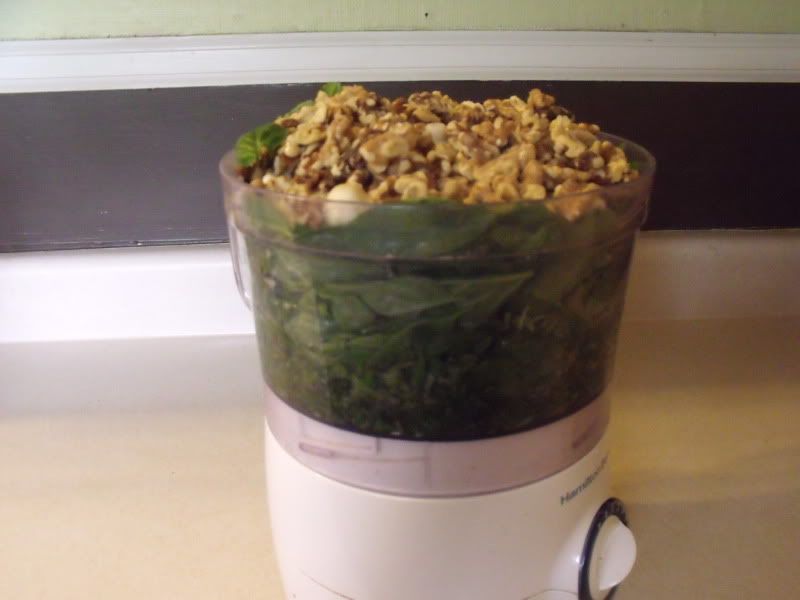
Layer everything in a food processor starting with the basil
Mix until it forms a thick, smooth paste.

I love my 14 cup capacity food processor for making large batches!


Thursday, June 23, 2011

Summer Ramblings


I've been neglecting my blog a bit lately. I've been distracted by beautiful summer days filled with children...

The sights, sounds and smells of childhood memories are carried on a summer breeze. Fairs and festivals, camps and cookouts, picnics and pools, bike rides and barbeques, sidewalk chalk and bubbles, fireflies, friends and windblown fields, homemade ice cream, all these things are the fabric of childhood. I want to soak it in moment by moment. All too soon the things of childhood are left behind and young adult responsibilities begin eek their way into our children's lives. I don't want to be in the kitchen or on the computer while that happens!

Thursday, June 16, 2011

Building Better Bread: Kneading

Everything has a rhythm. Everything Dances. ~Maya Angelou

Drawings of busy bakeries along with carvings of people kneading unearthed at Giza show Egyptian bakers from 4000 BC kneading dough with their feet! Apparently, when they they used their hands, the bread remained hard and flat but with their feet it was soft and fluffy. The origins of machine kneading date back to1751 in Solignac, France. Which may be why French bakeries always seem to be so much more advanced the rest of the world. Hand kneading is an art and if you are able to achieve the results you want there is no reason to change your ways.


Simply put, the purpose of kneading is to develop the gluten and produce a light springy dough. It can be difficult not to incorporate too much flour into the dough when hand kneading. If you have trouble with the dough getting too heavy try mixing your dough for a few minutes in a mixer and allowing it to rest before turning it onto a board. I like to work with a very soft dough. I have often found, when using freshly ground grain that the dough might be too wet to handle in the beginning but if you knead it a bit in a mixer and give the grain some time to absorb the moisture you will have a consistency that is easy to work with. 


As far as mixers go, with heavy baking I burned through many before I found one that will do a lovely job and hold up over time. I have used my Electrolux for over 10 years and it shows no sign of giving up. It is exceptionally strong with a huge 8 quart bowl that holds up to 7 pounds of flour. Even though it comes with a dough hook I only use the roller/scraper which creates a silky smooth elastic dough quickly.


Wednesday, June 15, 2011

String Cheese


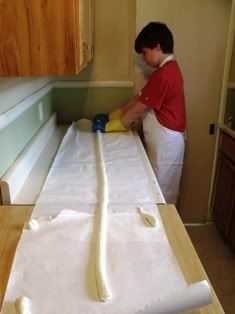
The origins of string cheese are a little hazy. Perhaps in some rustic Italian villa, a mother, anxious to keep her child busy while she finished her cheese, pulled off a piece for him to work. After all the word Mozzare means to cut off.

My kids love to make string cheese

Once you have mastered Mozzarella there is no reason you can't move on to making string cheese. There is no need for a special recipe just follow the directions to the point of stretching. Once you have pulled the cheese just stretch and roll it out then cut into strips and brine it for a few hours.